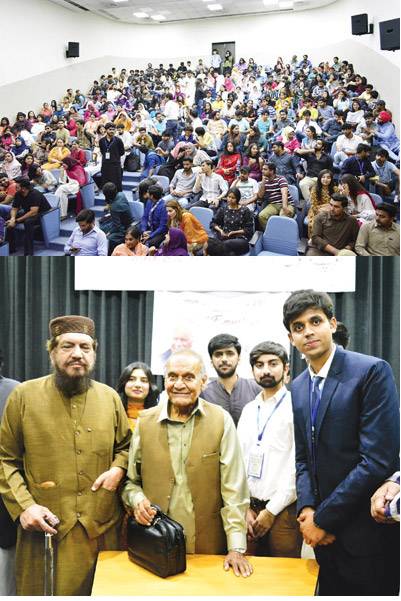

LAHORE – Empowering, Enabling, and Ennobling. The aforementioned words are not mere words, for they are the cardinal E’s, representing an ideology that’s been incessantly inculcated into the very fabric of FCCU from the start of societal tenure. Upholding the tradition of predecessors, the Ewing English Society, under the relentless leadership of its president, Irfan-ul-Haq, and the meticulous guidance of Ms Naomi Justin, orchestrated the third edition of the Forman Literary Festival. Ever since its inception, FLF has been the harbinger of innovation, with each execution surpassing the previous festival, elevating the standards for further assemblages, amassing individuals from diverse fields under the same roof, and curating an ambience of intellect as well as celebration, encompassing literature, arts, culture, identity, and everything in between, chronicling, constructing, deconstructing, and reconstructing an array of subjects, from contemporary to perennial. The first day began with opening remarks from the honourable Rector of FCCU, Dr Jonathan Addleton, who urged the listeners to challenge, inspire and express themselves through creative art while remaining rooted in inclusivity. This was followed by a note of welcome by the Dean of Humanities, and an introduction to the vision of the Ewing English Society by its president.“Literature feeds the famished intellectual appetite of the soul. Acknowledging and yearning for amenities of enlightenment, the Ewing English Society has attempted to advance the institutionalisation of literature, and create ventilating corridors for peaceful coexistence of humans. In this endeavour we are indebted in gratitude towards all those who facilitated and supported us from the beginning to the conclusion of this odyssey.” The first session revolved around “Nature and Literary Writing,” and began with words of Dr Fatima Syeda, the Chairperson of the Department of English Language and Literature. She reinterpreted Descartes’ quote as follows: “I am taught, therefore I am,” paying homage to teachers across the globe, and showing her gratitude for the role they play in refining literary tastes through the sheer richness of the ubiquity of language. Dr Fatima also had the privilege of introducing her teacher, from the keynote speaker, Professor Shaista Sonnu Sirajuddin, Professor and Chairperson of the Department of English Language & Literature at the University of the Punjab. However, the absolute polarity of tragedy is shown to be contingent, intertwined with ecological and biological themes. In the realm of Literary Ecology, humanity’s relationship with the dimmest parts of nature is explored, revealing a shared collective history shaped by natural processes. Echoing Rousseau, civilized humanity is often depicted as exiled from Eden, yet the human voice remains a conduit between the human and non-human worlds. The second session probed a delicate topic titled “Literature and Ethics.” Under the deft moderation of Dr Ateeq Anwar, the distinguished speakers, including Dr Noureen Khokhar, Dr Saadat Saeed, Dr Fakhar ul Haq Noori, and Dr. Salman Bhatt, delved into the nuances of the subject, providing a multifaceted overview of this fragile framework that penetrates all domains, whether literary or otherwise. It was asserted that the heart inherently discerns right from wrong. The next session, a hands-on workshop under the stewardship of Athar Tahir (Sitara-e-Imtiaz), provided a haven for enthusiasts delving into the intricacies of poetry—an art form as ancient as humanity itself. Participants delved into the foundations and evolution of poetry, including traditional forms such as Haiku (17 syllables), Tanka (31 syllables), and Sonnet (14 lines with varied structures). They learned how rhyme schemes were incorporated into sonnets and the importance of transparency in writing. Additionally, participants understood the distinction between blank verse, which follows rhyme, and free verse, which doesn’t. The workshop emphasized that not everyone could effortlessly produce poetry; it required dedication and learning. What followed the workshop was Dr. Farrukh Khan’s discussion, titled “Decolonizing Knowledge,” moderated by Dr Waseem Anwar. Their conversation traced the roots of the shackles that restrict the physical, cognitive, emotional, and social realms of the manner in which we exist. Indigenous decolonization underscores the significance of societal categories in shaping perceptions, debunking the fallacy of equating differences with inferiority. Just mimicking language, like a parrot, doesn’t confer humanity. Expanding centers of knowledge is crucial; literature isn’t confined to England alone. Ownership of language is empowering, contrasting with rote learning. Active engagement in learning, rather than passive memorization, was advocated. Providing a platform for the exploration as well as expression of various artistic mediums, a performance by Fazal Jutt on “Punjabi Folk Music and Oral Literary Forms” rejuvenated all, in addition to traversing cultural terrain. In accordance with the ever-changing contemporary global dynamics, a session titled “Pakistani Speculative Fiction in Focus” with Mr. Usman T. Malik, moderated adroitly by Dr. Qurra-Tul-Aen Liaqat, tackled the emerging art of Pakistani sci-fi and shed light on its prominent themes and motifs. Despite its ancient roots, with practices like memorization of the Quran dating back thousands of years, writing defies simplistic binaries, evolving from individual expression to a broader canvas of obsession. Lahore, with its dualistic modality shaped by Hindu history, serves as a rich source of narrative inspiration. In a world where Generation Z shows promise in reading and social activism, fiction remains a vital tool for understanding and empathizing with diverse experiences. Whether through traditional books or audio books, literature serves as a catalyst for self-reflection and empowerment, even in moments of grief or failure. Last, but definitely not least, a poetic symposium (Mushaira), bringing in the titan of poetry, Anwar Masood, who holds the power to make you cry tears of laughter as well as sorrow, mutually presided by the Chairperson of Urdu Literature, Dr Noureen Khokhar, and Mr. Abbass Tabish, along with other celebrated as well as renowned poets including Ms Rukhshanda Naveed, Ms Farhat Zahid, Mr Ammar Iqbal, Adnan Khalid, and Mr Hammad Niazi, along with the special presence of Mr Sulman Gillani, Dr Saeed Iqbal Saadi, Mr Shabeer Hussain Butt, Dr Fakhar Abbass, and Mr. Ali Dar, was the high point of the day. A day that kept on giving.
Forman Literary Festival; dedicated to contemplators
BY Pretty Lady
- May 13, 2024
- 0 Comments