


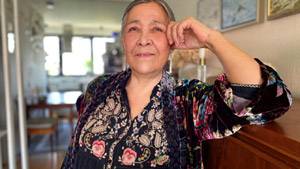
Birkerød, Denmark – Henriette Berthelsen was separated from her family at 11 and forced to wear a contraceptive coil, a trauma she buried until she and 142 other Greenlandic women sued the Danish state. “I’ve suppressed so much,” Berthelsen said. “I had an IUD (intrauterine device) fitted nine times since the age of 13, according to my medical records,” the psychologist and activist explained with poise and dignity. “Luckily — if one can say luckily — they fell out,” she said, her voice cracking. “I remember being in so much pain,” she told AFP at her home in a Copenhagen suburb. Now 66, Berthelsen is one of the 143 Greenland Inuits who have sued the Danish state for violating their rights during its forced contraception campaign from the 1960s to 1980.
Some 4,500 fertile women were forced to undergo the procedure, often without their or their family’s consent. Denmark carried out the campaign to limit the birth rate in the Arctic territory, which had not been its colony since 1953 but was still under its control. Berthelsen’s parents never consented to her coils.
At the recommendation of the state, she was sent to Denmark for a year as a young girl to learn Danish and then to a Danish boarding school in Nuuk, Greenland’s capital, far from her hometown of Qeqertarsuatsiaat in southwestern Greenland.
One day, “there was a sign that said that all the girls from the boarding school had to go to the infirmary”, she said. The IUDs kept falling out, she recalled, holding a photograph of herself from the time — a young girl with long dark plaits. For a long time she didn’t tell anyone about her ordeal, remembering what her mother had taught her: ‘Never contradict a Dane’. For many of her classmates, the experience had a devastating impact. “In my class there were several girls who were never able to have children,” she said. Berthelsen herself went on to have two kids. She is now campaigning to get the Danish state to pay for therapy for the victims living in Denmark. Greenland already pays such benefits to those living in the territory. Ebbe Volquardsen, a lecturer at the University of Nuuk, said the women were seeking justice now because the time was ripe. “It simply takes time for marginalised groups, including Greenlanders within the Danish realm, to develop an awareness of systemic inequality and the ability to articulate it as a problem,” she explained.
One of the victims spoke out in the media several years ago about the trauma she experienced.
A podcast series by Danish public broadcaster DR in 2022 then revealed the extent of the campaign.
“It’s important that the Danish state takes responsibility,” said Berthelsen.
“Some things happened as a result of colonialism” — like “deciding, instead of the people (concerned), whether they are too many or too few, committing a genocide, committing violence and offences against young girls”, she fumed.
Historian Soren Rud told AFP: “In the context of the 2020s, the authoritarian elements of the campaign stood out as a shocking example of how the colonial and post-colonial situation affected the interaction between Greenlanders and Danes.”